Showing posts with label Book. Show all posts

Friday, September 05, 2008

F4 ala Harry Potter

Hehehe... iseng sebenernya, tapi suka banget sama gambar ini di web post sebelumnya (HelloQuizzy).
Trus kalo dipikir2, ibunya HP kok kayak Tsukushi-nya Hana Yori Dango ya?
Dikelilingi 4 cowok ganteng... eh, not so sure about Pettigrew, though ;-p


AAARRGGGHHH, Sirius gantengggg!
(apa sihhhh?? ;-p)

The Harry Potter Husband Test

Your result for The Harry Potter Husband Test...

Mrs. Weasley Twin

Your perfect HP man is Fred and/or George Weasley.

Laughter is important to you. You want a guy who's never boring, who can always put a smile on your face, and who can pull the best of pranks and never get caught. Or possibly two such guys. Because let's face it, they're pretty much a two-fer. You get one, you get both. Even if one of them's only a friend, he'll still be around so much you'll feel like you're married to him, too. Sure, they may not seem like the most mature guys in the world, in a traditional sense, but just ask them about their business plan. When they drive you nuts by relentlessly testing their latest inventions on you, you can console youself with that huge stack of cash and dragon-leather jacket. Besides, you know you're powerless against those stereo smiles.

Take The Harry Potter Husband Test at HelloQuizzy

Thursday, May 15, 2008

Meeting Pamuk


Okay, totally admitting that I also have a "bule complex" now.

What I meant by "bule complex" is the feeling of bubbly excitement, sheer joy, and the "norak"ness of wanting to speak or have a Caucasians autograph and picture, one of the glorious heritage from having been colonized for hundred of years by the West. Hehehe...

Though of course, I cannot myself escaped from the paradox, of writing my entry in english--the tool of modern colonization, some would say--in most of the time.

But whatever... I don't care what this emotion is properly called, after all the definition of "bule" itself can be a different debate of identity for Turkish people, with their problem of being part Asian in culture and space, aka continent wise, but wanting to join the EU, etc.

But... HUAAAAA... I can still cry because of excitement! I really, with my own two eyes, with my own mouth, saw and talked to Orhan Pamuk. THE NOBEL PRIZE WINNER for LITERATURE: ORHAN PAMUK!!!!

Of course, I already bought two of his book (My Name is Red and Snow), and shamefully admit that I haven't finished reading both, just started actually... And when I said I talked to Pamuk, I meant was by saying "It was really a nice talk" to him and got his smile as a reply. But who cares, right?!? I got his picture and autograph in one of my books...


Anyway, the talk didn't only revolved around his books, but went into other more vast discussion about politic and humanity. One of the touching moment for me was when he said:

"Globalization does made our way of thinking similar in some ways, and this made us struggling for identity, for roots in our own country/culture. But if we're not careful we will be trap in our own bordered consciousness... about how this thing is Turkish and how that thing is Japanese, and so on... we must go back to the general humanity, the notion of all of us being from the same race: human being, with the same pain and joy. Because that is what we are."

...not exactly that of course, more or less, with much emphasize on the less perhaps, cause that's all my level of understanding could gave me

Bottom line, once again so very felt blessed by being here in Tokyo at this moment. ROCK ONN!!

Wednesday, February 28, 2007

Book: The Lady and the Unicorn by Tracy Chevalier


F
ound my self blushed quite a lot when reading this one. Unlike her other books (so far I’ve read: Girl with A Pearl Earring and The Virgin Blue) that usually handed us love scenes with more subtle and delicate ways, I found The Lady and the Unicorn explored “new” territory with more details. Not that I mind ;-p

Because come to think of it, in my opinion, the book voiced a lot about the human senses: sight, touch, taste, smell and sound—and not just because the Lady and the Unicorn tapestries themselves were named after these five senses. What better way to fairly put them in the story rather than exploiting them in its paragraphs?

Inspired by the beautiful (at least from the pictures, cause I haven’t saw it first handily) 5th century French tapestries, this book gave a story told by its characters’ point of views: the lady killer painter (Nicolas des Innocents) who created the tapestries’ designs, the nobleman (Jean Le Viste) and his family who hired the painter, the weaver (Georges de la Chapelle) and his family, Georges’ cartoonist (Philippe de la Tour), etc.

The plot was simple: the process of making the famous six tapestries, but what I love about Chevalier is: she can make a simple plot into intriguing story!

Before you know it, you’ll be making decisions on whose point of view that you like and whose that you’ll be dreading. Well, at least that’s what I did ;-) I enjoyed reading Philippe’s and Nicolas’ parts—reading the story from characters that have opposite personalities was so much fun, especially when “watching” them pursuing the same girl.

My favorite tapestry among the six was Touch. There’s something majestic and graceful about the lady in it, and I prefer her than the other ladies, they either too melancholy smiling their sad smiles, or too innocently young for my eyes.

Image source: http://www.tchevalier.com/unicorn/index.html

As I always do after reading Chevalier’s work, I also had fun browsing around for the historical background of this book: the weaving process, all about that century’s weavers, the tapestry patterns that century usually produced, etc. If you enjoy her books before, you’ll definitely fall in love again with this one.

Strongly agree with the Independent’s comment about this book: “Tracy Chevalier gives the kiss of life to the historical novel.”

Rate:
Published: January 2007, PT Gramedia Pustaka Utama Writer: Tracy Chevalier Translator: Pepi Smith Indonesian Title: Lady dan Unicorn Volume: 296 pages

Thursday, December 21, 2006

Book: If Only It Were True by Marc Levy

I like watching Mark Ruffalo ever since 13 Going On 30, and Reese Witherspoon has became one of my favorite romantic comedy’s actresses since Legally Blonde. So you can imagine how I felt for Just Like Heaven: LOVED it!

Reading on the back cover that this book was the original script for that movie, definitely made me curious. While reading it, I found a lot of details that didn’t make it to the big screen; the fate we have to accept for most books that had been turned into movies. Of course, afterwards the common comments usually would be “I like the book better” or “They cut off my favorite part of the book” or “And there gone the depth of the book” etc. When the debate between books and movies arise, most of the time I’ll join the pro books choir, with a BIG exception for the Lord of the Ring’s trilogy, of course—but that’s only because I haven’t read the book. Hehehe.

So I was kind of surprised when finding myself liking Just Like Heaven better than If Only It Were True. The fast pace of the movie fit right in and felt like a wise decision for the story. I even found, sometimes, the details in the book unnecessary and only prolonged the pages. The Lauren I read in this book was somehow felt different with Reese’s Lauren. It was hard for me to care for this character; there were some things that just felt off with her. Lauren’s love interest, Arthur, was more likeable—the emotions built surrounding him were more real for me.

If you have watched the movie then you would probably already familiar with the story: Lauren was a dedicated resident at the San Francisco Memorial Hospital who kept postponing life because of her profession. One catastrophe accident threw her into a deep coma. While everyone had given up hope, Lauren’s soul wondered in some kind of limbo, able to see and hear everyone but not the other way around.

And then six months later, one stranger, an architect, magically made a contact with her. Arthur found her in his closet; both of them were surprised to see and hear each other. After a while, bonds were made, and Arthur decided to help Lauren. How to do that? He had no idea, as he was the only person who could see her, hear her and talk to her. Arthur finally found himself with no other choice but to go to the extreme when the doctors were preparing to end Lauren’s physical care.

So, the main thread was the same as the movie, but with more details in Arthur life in this book—about his mother, and her life also. I became more certain in the middle of it that the book was originally more about Arthur than Lauren, unlike the film.

But funny how when the time has sunk for a while and I looked through its pages again, now I have to admit that this book was a good reading. It’s very romantic and in its own world. Reading it, we would temporarily live in a place that only three people could experience: Lauren, Arthur and you, the reader. Ever since the first line, there’s this different “taste” that I couldn’t distinguish. Could it be because this book was originally published in French?

And of course there were these beautiful words put out by Marc Levy in it that I would like to share with you:

“What I have to tell you is not easy to understand, impossible to accept. But if you will listen to our story—if you are willing to trust me—then maybe in the end you’ll believe me. And it’s important that you, in particular, should believe me. For without knowing it, your are the only person in the world I can share our secret with.”

Rate:
Genre: ChickLit, Romance
Volume:
246 pages
Images:

www.rottentomatoes.com for Just Like Heaven
www.gramedia.com for Indonesian version of If Only It Were True: Andai Dia Nyata

Tuesday, October 17, 2006

Book: The Miraculous Journey of Edward Tulane by Kate DiCamillo

What a wonderful heartwarming book! Just by carrying this 198 pages, you’ll instantly know that this book was gonna be different. The warm and beautiful illustrations of Bagram Ibatoulline themselves had made this book worthy of collectors’ item. And after you’ve read the story… you’ll know you’ve bought a long lasting book.

Kate DiCamillo was well known for her award winning The Tale of Desperaux. I haven’t read it, this was my first of hers. But after this book, DiCamillo’s works will certainly be on my lookout list.
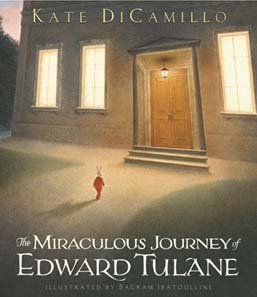
The story was about Edward Tulane, a blue china rabbit. He was beautiful with real rabbit's fur on his ears and tail, tall body, and eyes that were painted a penetrating and intelligent blue. But Edward was vain and loves only himself; he didn’t even like it when people called him “a doll” or “it”, and he didn't even truly loved his owner, a little girl named Abilene. But on an accident, Edward was forced to start a journey that will help him in finding true love.

Edward’s journey took me on an extraordinary experience, I quote: “…from the depths of the ocean to the net of a fisherman, from the top of a garbage heap to the fireside of a hoboes' camp, from the bedside of an ailing child to the streets of Memphis.”

Sounds like an average story to you? Well, believe me, my shallow writing is certainly will not be sufficient enough to help you truly understand why I totally love this book; you’ll have to read it for yourself.

With its simple yet very deep story, this book gave me the new meaning of children’s book. It gave me the feeling of reading Paulo Coelho’s The Alchemist: you know, when you finally see and find that the thing that you’ve always looking for is actually already there, in front of you; the feeling that while already knowing the ending, you don’t mind in searching because you know you’re gonna really enjoy the process. And want to know something? When reading the last passage on this book, I had goosebumps all over!

Image: http://www.amazon.com/Miraculous-Journey-Edward-Tulane/

Tuesday, October 10, 2006

Book: Iblis dan Miss Prym by Paulo Coelho


Translated from: The Devil and Miss Prym
256 pages

The story was about a little village called Viscos, where perfect peaceful life was condemned as hell-like. One day, the devil arrived with a stranger. The stranger offered Chantal Prym, an orphan girl who likes nothing better than to leave her village, some amount of gold as a prize if she chooses to help him announce a bet between him and her people. The stranger would like to prove that Evil, and not Good, was the very essence of human nature and therefore it will always prevail in the end. He promised to give all of his gold to the people of Viscos if, and only if, they do the unthinkable: someone must be found dead in that village within a week.

Quite promising, right? But sadly, the execution didn’t deliver what I expected. I expected a tight-suspense-psychological story of the classic war between Good and Evil. Instead, I found something somewhere and somehow was lacking the formula. The storyline was felt a bit flat for me, not as gripping. Though of course, I read it till the end for wanting to know what decision Miss Prym and the people of Viscos made.

As one of many people that were/still are inspired by The Alchemist, I have to admit that this book didn’t give me new insights, unlike its former. I also missed the awakening-thoughts-from-within in it; felt like reading an old religious book that dwells on old issues. I’m not saying that it gained a half star out of fives, but maybe it’ll help if you didn’t expect too much.

image: www.gramedia.com

Friday, October 06, 2006

Book: Sebuah Panduan Lengkap: Puasa dan Bulan Ramadhan by Ali Budak


Translated from: A Comprehensive Guide: Fasting in Islam and the Month of Ramadan; Rp 35.000; 206 hlm

A nice read, suitable especially in the holly month. I got a lot of (new or not) information about fasting—of course, especially its details that more often than not may have slipped my attention when performing this practice. I also like the part where the author added some history of fasting practiced in other religions (Judaism, Christians, and in non-Abrahamic faiths).

The Q&A pattern of this book was helpful. It made the reading process simple and fun. The feel you would get will be “light reading”—something you probably prefer when reading a religious book.

Some of the points/questions in the book that I found interesting:
- As one of the five pillars of Islam, fasting has a special quality that is not found in anything else and that is its close connection to God; He says: “Fasting is for Me, and I shall reward it.” (Hadist Abu Hurayra).
- Fasting makes the sincerity of one’s faith and devotion God all the more evident.
- Some people say, “Those who do not perform daily prayers or are not careful with their other religious duties should not fast in vain.” Is it not possible, then, for a sinner to worship?
- Do things such as vaccinations, toothpaste, and others invalidate the fast?
- What is the most complete fast? (Tongues against lies; Hands against forbidden acts; Stomachs against ill-gotten food; Eyes against unlawful looks; Ears against listening to lies, gossip, and backbiting; Feet against the pursuit of bad deeds.)

Personal note: I’m soooo thankful for working a desk job in an air-conditioned company. Alhamdulillah! Praise to Allah! Could not imagine practicing it while doing hard field works.

Wednesday, September 27, 2006

Book: Artemis Fowl #2: Insiden Arktik by Eoin Colfer


Translated from: Artemis Fowl: The Arctic Incident; 360 pages; September 2006; Gramedia Pustaka Utama

I think it has been a year since I read the first book of this series: Artemis Fowl, but I still remember that it was a nice treat. Cause you must’ve had read a lot of fantasy books that offered you adventures with the elves, dwarfs, trolls, pixies or any other magical creatures nowadays—the result of the after Harry Potter effect. Artemis Fowl gave you a sort of Richie Rich met Eragon with a splash of Beverly Hills’ Cop. In more humanly language: an adventure of a rich and genius boy with fairies who instead of behaving in a fairy-like manner, they come with the attitudes like human cops in a police story, complete with fairy’s version of bad cop-good cop. Interesting, right? RIGHT-O.

If you thought the first book was fun, you would’ve loved the second one. I know I did. On this story, instead of fighting against the People and any other Lower Elements’ officers, Artemis had got himself into a situation where he had to work with them, more specifically with his past nemesis, Captain Holly the elf.

Artemis was on his routine life, making criminal genius plans and giving headaches to his educators in Saint Bartleby’s School, when a video mail came. In it: a ransom demand for a man—a victim of a ship wrecked in Arctic, North Pole. The abductors claimed that this man was Artemis’ father, Fowl Senior, who had been listed by any governments as already deceased. Artemis and his trustworthy and deadly bodyguard, Butler, quickly made traveling plans, knowing that they didn’t have the time to stay put and think. They would have to figure out the rescue plans along the way.

At the same time, Haven City and its Lower Elements Police (LEP) were on a panic because they just discovered that B’wa Kell, goblins’ notorious triad, had been smuggling Class A goodies: human batteries for powering old soft-nose lasers. These weapons were already declared illegal decades ago and were supposed to be on LEP’s recycle list. But the goblins didn’t have the brain to think all of this alone; there isn’t even enough electricity in their brain to light a 10-watt bulb. So who’s behind it? One name stood up in Captain Holly’s mind: the kid that had robbed them the elves’ gold, Artemis Fowl himself.

Holly had to swallow her pride when she accepted that Artemis was not the brain in all this commotion. The kid was busy with his own concerns. Skillfully, the thirteen years old boy flipped the situation to his advantages. He would helped the People unraveled the elf behind the smuggling and the potential plan behind it—after all they need his and Butler’s expertise to move around the upper ground—if they help him rescue Fowl Senior. The plan was simple enough but complications aroused: a coup d’état by the Council’s ex-golden boy seeking sweet sweet revenge, and sabotages to the elves’ technologies that had leaved our heroes vulnerable to goblins’ attacks.

What I love so much about Eoin Colfer was his sense of humor. He really could make characters that are loveable with their own traits. My favorite was of course the head of LEP, Commander Root, who was “lovingly” nicknamed Beetroot by his officers, due to the likeness of his face with this certain vegetable when he’s steamed. And then there was Foaly, a centaur who was the LEP’s tech genius with a horse sized ego. I was very glad that these two characters got more parts in this book. Couldn’t stop giggling cause of their witty dialogues.

Bottom line, Artemis Fowl: The Arctic Incident promised and delivered tons of fun actions. Therefore, you certainly will see me sitting nicely, waiting devotedly for the translation of the third.

Tuesday, September 26, 2006

Book: Beautiful Stranger by Hope Donahue


Indonesian title: Beautiful Stranger—obsesi seorang remaja untuk tampil cantik dan sempurna melalui berbagai bedah plastik
415 pages, August 2005; Gramedia Pustaka Utama

After a long long journey, I’ve managed to finish this book. It first caught my eyes, after I watched the first season of Nip/Tuck (TV Series). I wanted to know more about plastic surgeries, what drive people to do them, and so on.

The Indonesian version’s cover was really catchy, definitely tickled my interest to read it. Sadly, the content of the book did not have the same effect. First of all, I didn’t expect tons and tons of self-indulging monologues. Second, the timeline of the story was felt kind of like a haze; I didn’t know at what age she was when telling the A story, or when did this B story happen? After the A or before it? I mean, just because you’re telling a story of a mix-up person, can you really used a mix-up storyline and expect the readers will just follow without raising an eyebrow out of confusion? Third, I didn’t felt the emotion; well, not all blank but still too little to mention. For a Real Life book, aren’t you supposed to felt what the author felt? Went to the places he/she went? Though this maybe caused by the translation process.

Out of 415 pages, the reader was dragged into Hope’s world of emptiness chaos, caused by—I think—lack of confidence, the need to look perfect, the loss if not looking beautiful, the search of love and acknowledgement, in the prior 350 pages; the part where the something that resemble the resolution only came after that, at the last 65 pages. So it’s like holding your breath for the longest time, but then when the chance of exhaling came, it didn’t last long, leaving you rather unsatisfied—wanted to use the word “strangled”, but felt it would be too much.

I didn’t get what I want from this book, but I have to say that I like the parts where she described her feeling before and after the surgeries. And I’m so glad that she finally decided to remove the silicon in her breasts. I agree it was a good start for her recovery, and admire her for admitting that the end of this book couldn’t be the Hollywood’s type of ending because she is now still struggling to get better.

Thursday, June 29, 2006

Book: Betsy and the Emperor by Staton Rabin


A friend recommended this book to me, and since I’m such a sucker for historical novels, I easily agreed to read it. The cover itself had an appeal, it showed the face of an 19th century girl, complete with her blond curls and gown, and by her side, the face (half of it anyway) of Napoleon Bonaparte. Oh, but the image I posted here is the Indonesian edition, Betsy dan sang Kaisar. Anyway, I always welcomed novelized version of historical figures’ biographies, I really enjoyed the manga The Rose of Versailles by Ryoko Ikeda, which portrayed the life of Marie Antoinette. I must confess I haven’t read many writings about Napoleon, perhaps only a few in-depth articles about his love life in a woman magazine many years ago.

Ahhh, I remembered now, I actually own a manga series based on Napoleon’s life, Eroica. Sadly, this 13 volumes (if I’m not mistaken) collection was incomplete, only by one volume (and get this, the one I didn’t get was the last volume!!!) But since the illustrations were not as appealing as Ryoko Ikeda’s, I’ve lost the appetite to complete such an old manga.


Okay, hold your horses! (What horse? you’ll say. Hahaha) I have a point here, I’m not just blabbering pointlessly ;-p. Speaking about Eroica, the articles and now this book, I noticed one similar thing about Napoleon that seemed to inspire many writers: his deep love for his first wife, Josephine. In Betsy and the Emperor this tradition lingered and several times, rather vividly, and was spoken out in Napoleon’s expressions while talking about her.

The story took place at the early of 19th century, 1815, in the island of St. Helena. Young and full of spirit, Betsy always looked at everything with the passion for adventure. Even though she had to return to the desolated island after having her education, she actually felt glad because she despised her dorm-school. The peaceful St. Helena was getting its spotlights when the notorious Napoleon arrived at the island. Betsy and her family was the one getting a bigger surprise because the emperor was going to stay at their mansion while waiting for his appointed “cell”.

Like any other story, at first Betsy was both agitated and intrigued with their new curious guest. But after a while, they somehow had become card playing and horse riding friends. Betsy even tried to help the emperor escape from the island. Their friendship was facing challenges when the new governor arrived and made new more restrictions for Napoleon.

Maybe I should’ve realized that I couldn’t expect too much intrigue from a teenage novel. After all there was enough portion about how Betsy was gossiped to be Napoleon’s newest love affair (a 14 year old girl was considered to be mature enough at that time, right?). With Napoleon reputation as a love adventurer, the novel pictured his relationship with Betsy quite modestly; thank god it didn’t go too far, and after all too much would be too gooey for me! I was quite—even tough not much—entertained. For what its worth, this book made me browsed more information about Napoleon in the Encarta Encyclopedia—a good sign for a book for me.

There was one trivia remained: How do you pronounce Bonaparte anyway?--the right way for it. Is it with a silent “e” or the vocal must be pronounced clearly? I have asked several persons (even a friend who studied French). But even she was dumbfounded, saying that the Indonesian way of saying that name was unfortunately already rooted deep in her head. Hmmm…

Image: Thx to Donna
Tuesday, June 20, 2006

Book: Batman Hush

Jeph Loeb (writer); Jim Lee (penciller); Scott Williams (inker)
Two volumes

Right now, I didn’t know how I could neglect such a masterpiece like Batman Hush! I am really ashamed for myself. Yesterday I just remember that I have bought the long wanted graphic novels and let them still in a brown envelope, wrapped untouched inside their plastic covers. Desperately tired in reading books (with no pictures ;-p) and watching movies, I reached for the envelope and finally ripped open the plastic wrapping of the first volume. Once started, I couldn’t stop (well, I stop only for a few nature calls, singkong chips and water) and not long after that impatiently ripped the plastic wrapping of the second one.

You know how you hated the time when you already know who’s the criminal mastermind behind all the horrible things gonna be? Well, I was never really had high hopes for this graphic novel, but it turned out that I was wrong about who’s the bad guy was for about two times! I was right the first time but then that person died… so I have to direct my suspicion to other character… but then remember maybe the murder was a cover up… but hesitated again… then the story brought out a “new” character and I believe that he’s the one… but I was wrong again… so well, I kind of give up and willingly let myself carried by the story… I was very glad that the ending was unlike anything I expected.

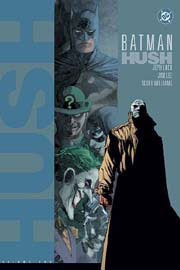
In Batman Hush, Batman experienced many crimes that seemed to be well-planned, so he was eager in finding out who was the criminal that seemed to know very much about him and his enemies. His search involved many of the Gotham City well-knows criminals such as Croc, Poison Ivy, Catwoman, Joker, Two-Faced, and The Riddler. Batman even had to went on a journey to the past (showed on panels which were generally colored in monochrome) and contemplated his love-enemy relationship with Catwoman. The great thing about this story was Batman got to go to Metropolis!!! Yup, it’s the city of Superman. I always like stories that joined superheroes in one story. Superman and Lois Lane, his wife, got to enjoy some panels in volume 1 and a glimpse in volume 2. Love it, when Batman several times said that “Clark was basically a good guy, and always will be”—and you can see this, in a subtle way, on Batman’s and Superman’s faces (the stroke of lines, colors, Batman’s grim mask, Superman’s simple haircut and features). While Batman always commenting Superman’s nature as a journalist, he got several remarks on how he was such a good detective.

For a not-so-fanatic-about-superheroes’-comics-person like me, the story was probably had some unfamiliar facts that had already known to the comics’ fans. Such as: who is Oracle? When did Lois and Clark got married? Who is Huntress? Is she Batgirl reformed? Robin is now not Robin but Nightwing? Then who is the Robin now?--questions. But gladly, Batman Hush supplied enough information for an amateur like me; therefore I could still enjoy the story line without being puzzled much. After all, too much information would no doubt destroy the plot itself.

The reason that I didn’t read too many superheroes comics was I don’t really enjoy watching the thick lined illustrations they have. Always think of them as boys’ reading. I much prefer the two dimensions, simple colors and lined comics of manga. But this time I was amazed by the awesome work of Batman Hush team, Joker’s face was soooo menacing, I didn’t have the guts to stare at it too long. And the feminine curves of the ladies… need I say more? Enough to make any woman envious! Boys, they are not real! None of them really look like that in the real life! ;-p

Although I read the Indonesian edition of Batman Hush volume 1 and 2, published by M&C Comics, I couldn’t find the images for them. So, sadly I have to post the English’s version covers. They almost look alike with the exceptions that the first volume of Indonesian edition was dark blue and the second was red-brownish (chestnut) colored.

Anyway anyhow… you should try to browse for this one! Definitely!!! (Boy, I feel a new strong addiction is coming up. Wallet, beware!)

Thursday, June 08, 2006

Book: The Virgin Blue by Tracy Chevalier


Chevalier always amazed me with her details in cities, buildings, and every history related matters when building her stories. The Virgin Blue (VB) was the second Chevalier’s writing that I’ve read after The Girl with a Pearl Earring (GPE). Before VB, I’ve seen Falling Angels’ Indonesian edition, already borrowed it but don’t know when will it get its chance (glancing hopelessly to Paulo Coelho’s, Banana Yoshi-moto’s, and Marjane Satrapi’s Persepolis 2 on my bed.)

Anyway… must comment on VB’s cover. On the back cover, it was said “Cover shows a detail from Portrait of Mademoiselle Alice Guerin by Paul Cesar Helleu (1859-1927). Musee Bonnat, Bayonne, France.” I must say Chevalier and her team’s choice on paintings for her books’ cover was outstanding, the blue eyes and red hair on VB was beautiful. This actually pops up a question in my head, did Chevalier saw all of the portraits before writing her novels or was it the other way around? The portraits endorsed her imaginations to write?

The Virgin Blue took 16th century Europe Protestant Reformation as the background. Unlike GPE, the story was presented from two women’s point of view. Isabelle du Moulin, later became Isabelle Tournier, who lived in the 16th century; and Ella Turner an American who tried to know more about her Tournier ancestry four hundred years later. The virgin blue connected them: Isabelle was fascinated by it, while the color disturbed Ella in her dreams. The amazing part was, even though Chevalier didn’t put extra pages to write what year was the story on each chapter took place like in GPE, ever since the first page, I knew that she’s telling two stories with two point of views, in two different time periods. We can felt the difference of culture, language and the society’s characters that enveloped these two women in the sentences of every chapter.

Isabelle was known as La Rousse because of her red hair. She was shunned and tormented in her village because of this physical trait; people associated her with witchcraft and condemned her because the red hair reminded them to the Virgin Mary, while the village believed that the Virgin was barring their way to the Truth--following John Calvin who was one of the Martin Luther’s associates. Isabelle’s heart was with the Virgin but she had to conceal this, because she felt that she couldn’t bear any other “guilt” that was already threatening her. Later she married Etienne Tournier, not because of love, but because she carried his child, and began her life as a member of family that hold prejudices upon her until the end.

Ella Turner came to Lisle-sur-Tarn, a small French town, with her husband Rick. She tried hard to fit-in in her new house: changing her name back to Tournier and polishing her French. But she was still left disappointed, isolated and lonely. When she decided to investigate her ancestry, she met Jean-Paul, a French librarian, and unexpectedly drawn to him. I love the way Chevalier compared the two men in Ella’s life. Rick was described to be so Californian, with blond ponytail, skins tan, and always a positive attitude. Jean-Paul was the opposite pole, with sardonic smiles and sharp brown eyes; he always ready to bring up the pessimistic side of Ella’s opinions.

I have to admit, the first chapters was a bit slow. If you expected fast-pace-full-of-actions kind of book, you will be very disappointed. I would recommend you to take it easy and enjoy the journey in every French town Chevalier took us, grinning and smiling on Ella Turner’s comments on the French “hospitality”. Only then, will she took you by surprise with the revealing of secrets that will fast drove you all the way until the last page.

The downside was, after all the long journey of implicit signs and subtle feelings; I was kind of expecting a more Hollywood’s ending (you know, the hug, the kiss, the “I love you so I’ll stay” and all that crappy yet satisfying to look at—or in this case, to read—stuffs). This, of course, was my very own mistake. Nevertheless, it was refreshing to read a different point of view on the Europe Protestant Reformation after seeing the movie: Luther (played by Joseph Fiennes). Chevalier stays to be one of my favorite historical novel’s writers.

Tuesday, May 16, 2006

Book: Kiki's Delivery Service


Japanese title: Majou no Takyubin
Fukuinkan Shoten, 1985

Just finished reading Eiko Kadono's Kiki's Delivery Service last week, the japanese edition published by Fukuinkan Shoten. As I am a Ghibli Studio's fan, I have been longing to read it. The movie was not as fantastic as Spirited Away, but still felt warm like other Ghibli's movies. When I tried browsing away for this book's info, I found that the book actually have been translated into English and Italian!! Imagine that, huh! Anyway, I heard that the Indonesian edition will also come out soon this year. Oh yeah, I also found out that Majou no Takyuubin (the japanese title for this book) is actually a series. Didn't know much yet, but apparently there are three volume in this series, when the story developed until Kiki is a grown-up. I wonder if she will end up marrying Tombo-san? Hehehe.

The story was about a little witch, Kiki, who--according to witch tradition--has to leave home and find her own town when she reached the age of 13 years old. On this journey, she will only be accompanied by Jiji, her black cat. The sentences and words used in this book was simple, the same can be said about the story. The whole 153 pages was dedicated for Kiki's and Jiji's adventure in trying to fit-in to their new community. Having read the book, I would say that Hayao Miyazaki has done a great adaptation of the book, choosing only the strongest stories from the over all adventures.

Still, it was a nice book. I wonder how's the english translation...?